


















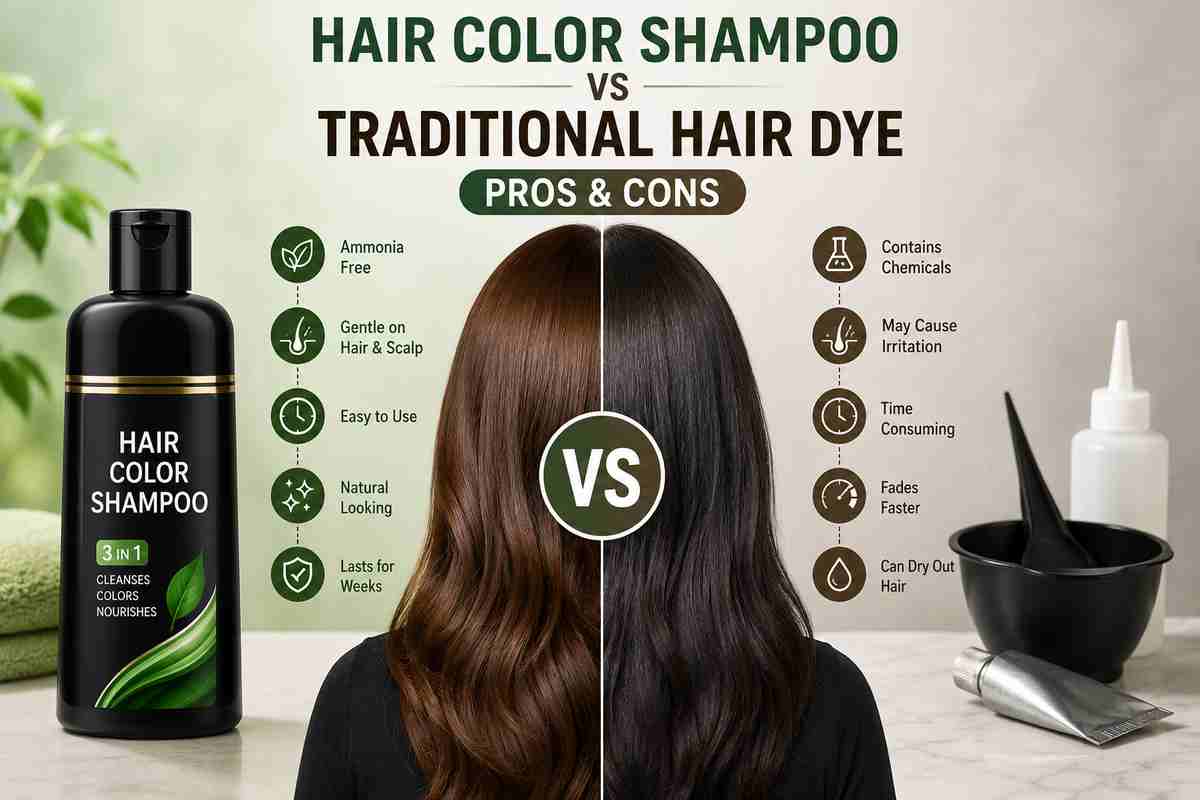
Grey hair comes to everyone eventually. When it does, you find yourself standing in a store aisle looking at two very different options. One package says ” color, salon results.” One bottle says ” shampoo, no mess, no ammonia.” Both claim they will fix your hair. Only one of them is sharing the truth.
If you have been delaying the decision because you really don’t know which one is right for your hair, your routine, or your level of patience. This comparison should help you decide.
What Hair Color Shampoo Actually Is
Hair color shampoo isn’t a trick, even though it seems simple to be true at first. It is a colored ammonia (often ammonia-free) formula that slowly adds color to the hair each time you wash it. Think like “dyeing” and more like “touching up.” You wash, you wait a minute, you rinse. And grey strands gradually mix into your natural color over time.
This category has grown fast in Pakistan over the past few years, partly because of how harsh our summers are on chemically treated hair and partly because people are tired of planning their week around a salon appointment. Brands like Lichen have created product lines around this idea, and the appeal is clear once you try it.
What Traditional Hair Dye Involves
Traditional dye is the process most of us grew up seeing our mothers or barbers do. Mixing a color cream with a developer, applying it section by section, waiting 30 to 45 minutes under a cap, and then rinsing out what is usually a strong chemical smell. It is permanent (or semi-permanent depending on the formula) it covers grey completely in one session. It has been the standard for decades because, simply, it works.
It works” doesn’t mean “it works without a cost.” Ammonia-based dyes open the hair cuticle to put color in the strand, and that process is exactly what makes hair feel drier, more brittle, and more likely to break over time. Especially with repeated uses every four to six weeks.
Hair Color Shampoo versus Traditional Dye: Quick Comparison
| Factor | Hair Color Shampoo | Traditional Hair Dye |
| Coverage speed | Gradual (3–5 washes) | Instant, full coverage |
| Ammonia content | None or very low | Higher |
| Hair damage risk | Lower | Higher with repeated use |
| Application time | Minutes in-shower | 30–45 minutes, dedicated session |
| Maintenance | Regular washing keeps color topped up | Root touch-ups every 4–6 weeks |
| Shade precision | Limited range | Highly customizable |
| Cost over time | Lower; one bottle lasts weeks | Higher; repeat purchases/salon visits |
Pros of Hair Color Shampoo
- Convenience is the obvious advantage: You are not setting aside an hour of your day. Booking a salon appointment. It fits into a shower routine you are already doing.
- Gentler on hair health: Most formulas do not use ammonia. Use such low amounts that the damage is nowhere near as bad as a full dye job. If your hair is already dry, colored, or chemically treated, this matters more than people think.
- Gradual results look more natural: Because color builds up over washes instead of appearing all at once, there is no sudden “I just dyed my hair” look.
- Lower cost over time: A single bottle lasts weeks to a month with regular use compared to buying a new dye box every time roots show.
- Easy for beginners: No mixing ratios, no timing stress, no chance of application from doing it yourself at home.
Cons of Hair Color Shampoo
- Grey coverage is not instant. Expect 3 to 5 washes before you see real change
- Requires use; skip it for a few weeks and grey starts coming back
- Very hard or coarse grey hair may need more washes than suggested
- Color options are more limited than professional dye, which offers exact custom shades
Pros of Traditional Hair Dye
- Immediate full coverage. One session result. If you have an event tomorrow, this is still the reliable option.
- More shade. Accuracy. Salons and box dyes offer more customization. Highlights, balayage, exact tone matching. None of which shampoo formulas are designed to do.
- Longer lasting between touch-ups. A good dye job keeps color at the root for four to six weeks before regrowth becomes obvious.
Cons of Traditional Hair Dye
- Ammonia and peroxide can make hair dry, frizzy, and more likely to split
- Root touch-ups become a time and money commitment
- Higher chance of scalp irritation for sensitive skin
- Harder to do evenly at home without help
- Strong chemical smell that stays for hours after application
So Which One Actually Fits You?
This isn’t really about “which’s objectively better”. It’s about “which fits your life.”
If you want complete one-time coverage for a wedding, interview, or event and you don’t mind the maintenance cycle, traditional dye still does the job it’s always done.
If you want low-effort maintenance, healthier hair on the run, and you’re okay with color building up gradually rather than instantly, hair color shampoo is genuinely one of the smarter choices you can make this year. Especially if your hair has been through repeated dye damage and needs a break.
Many people in Pakistan are choosing an approach too: an initial traditional dye for full coverage, then switching to color shampoo for maintenance in between full color sessions. It reduces chemical exposure significantly while still keeping grey away.
Making the Switch Without the Guesswork
If you are leaning towards color shampoo, the quality and formula matter a lot more than the marketing on the bottle. This is where GetNow.pk becomes useful. You can compare formulas, shades, and reviews before making a decision rather than guessing based on whatever is on a random store shelf.
For anyone starting this process, looking at the Hair Care section on GetNow.pk is a first step to understand what condition your hair is actually in before adding color into the mix. From there, the dedicated Hair Color section on GetNow.pk splits options by formula type so you’re not choosing blind.
If you already know you want the shampoo route, Lichen Hair Color has become one of the more trusted names for this in Pakistan, with the Lichen Hair Color Shampoo BOTTLE LARGE BLACK AND BROWN being a popular choice for a full-size, longer-lasting supply. Those with more damaged strands often use it with LICHEN ARGAN SHAMPOO for extra nourishment during the color-building process.
If you are not ready to commit to shampoo-based color yet and want something closer to traditional results, LICHEN COLOR GEL BLACK AND BROWN offers a middle-ground formula worth checking on GetNow.pk. For anyone dealing with sensitive skin or dryness alongside grey coverage, the LICHEN GINGER SHAMPOO and Conditioner combo is worth adding to the routine for extra scalp comfort.
FAQ’s
Does hair color shampoo really work?
Yes, though results take time. Most people see grey coverage after 3 to 5 washes, with color getting deeper as you continue using it.
Is hair color shampoo safe for use?
Most formulas are ammonia-free or very low-ammonia, making them much gentler than repeated dyeing, though patch-testing is always a good idea for sensitive scalps.
How long does hair color shampoo last between washes?
Color fades gradually with each wash; regular use (about 2 to 3 times a week) keeps grey covered without it coming back.
Which is better for grey hair, shampoo or dye?
It depends on how urgent you’re how your hair is doing. Dye provides instant, full coverage, while shampoo offers a gentler, lower-maintenance option for those willing to wait a few washes.
Can I switch between hair color shampoo and traditional dye?
Yes, a combined routine. A dye session followed by color shampoo for maintenance. Is a common and effective approach.
Final Word
Neither option is completely right. Traditional dye still wins on speed and accuracy. Hair color shampoo wins on convenience, gentleness, and long-term hair health. The right choice depends on how much time you are willing to spend, how your hair currently handles chemical treatments, and how patient you are with gradual results versus instant ones.
No matter which one you choose, buying from a source that actually stocks real stored products makes a bigger difference than people realize. Half of the “this didn’t work for me” complaints online come from fake or expired products rather than the formula itself.